
When you’re running a business, there’s always something that needs doing.
A customer to call, a proposal to write, a decision to make. And when you’re busy getting through the to-do list, it’s easy to fall into familiar patterns and struggle to see beyond what’s right in front of you.
But developing creative thinking skills doesn’t mean hastily scheduling a brainstorming away day or panicking waiting for a brilliant idea to arrive. In fact, I think some of the best ways to improve creative thinking in the workplace have very little to do with work at all. Think of it as a regular little workout for your brain: making unexpected connections, exploring possibilities and getting comfortable with ideas that seem a bit ridiculous at first.
Here are some of the things I do to keep my mind whirring happily. I’ll keep updating it as I find new habits that help so if you like the page, feel free to bookmark it - and if you have things you think are missing, drop me a line hello@makeitwhirr.co.uk - I’d love to hear them!
1. Give your ideas some legs
We all know a walk can clear your head. But what if it could help fill it with ideas too?
A Stanford University study found that walking increased people's creative output by around 60% on average, when tested on their ability to generate original ideas.
Even though we’re spoilt for choice for scenic walks in Norfolk, it turns out it’s mostly the walking itself - not the scenery - that makes the difference. The researchers found that walking indoors on a treadmill boosted creative thinking almost just as much, , proving that simple physical movement matters more than getting out into the fresh air.
The study also suggests that while walking helps you generate fresh ideas, it doesn’t help with problems that have only one right answer. So sadly your budget crunching may still be best done at your desk!
Try this: Next time you want to generate some fresh ideas, get up and go for a ten-minute wander. Rain or cold weather are no longer excuses - even a potter around the office or up and down the corridor is fine!
2. Look up and think bigger (and then have a lie down!)
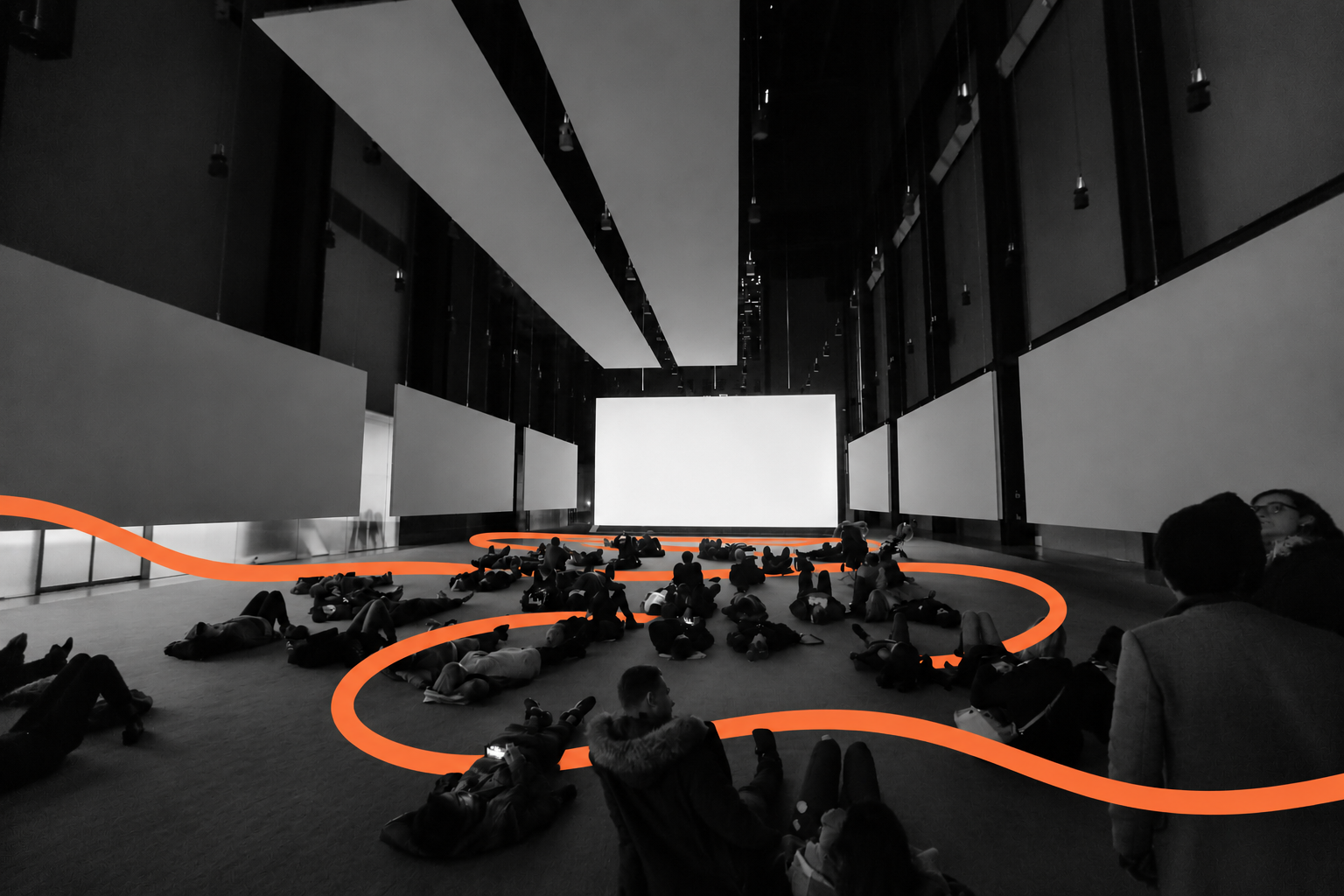
When I worked in London, I’d sometimes take our brainstorms to the Turbine Hall at Tate Modern.
We’d lie on the floor on our backs, look up and think, in a huge space that definitely seemed to make everyone’s thinking feel bigger. It sounds like we were just messing about, but intuitively we knew there was something freeing about looking up into a void and just saying what’s in your mind.
And, it turns out there’s actually a bit of research on why this might be!
Something termed the ‘Cathedral Effect’ suggests high ceilings nudge people towards freer, more abstract thinking. On the flip side, low ceilings may promote focused, detail-oriented thinking. (Something to keep in mind if you are planning an office move or refit.)
And if that wasn’t enough of an excuse for staring up at ceilings during work time, one small study by researchers The Australian National University found people solved anagrams faster lying down than standing up. (If you like the science bit, the authors proposed that lying down increases baroreceptor load, which in turn reduces activity in the locus coeruleus-noradrenergic system).
It doesn’t definitively prove lying down at work gives you ideas, but it feels like a legitimate excuse to try!
Try this: Next time you want to think bigger, take the problem somewhere with a high ceiling, or no ceiling at all. Or lie on the floor for ten minutes. And if you’ve got a tricky spreadsheet to fix, maybe that’s (sadl for some) your sign to sit in a little, compact room on your own for a few hours.
Here are a couple of places in Norwich/Norfolk with some high ceilings you could try:
Sainsbury Museum & Art Centre, Norwich Cathedral, Norfolk Chambers of Commerce, St Margaret’s Gallery, Artidote studio, B&Q Boundary Road, Norwich Station, The Forum, Norwich, Jarrolds Letheringsett, Pace Padel, Cosy Club Norwich, The Dabbling Duck, The Dragon Hall (where am I missing? hello@makeitwhirr.co.uk)
3. Play mobile games
I’m a big fan of a quick game of The New York Times games like Wordle and Connections. The latter asks you to sort sixteen seemingly unrelated words into four hidden groups. You’re spotting patterns, testing possibilities and stepping back when the obvious answer (the dreaded red herring!) turns out to be wrong. It’s like Only Connect but without the time pressure.
A lecturer at UBC’s Sauder School of Business, who’s written a book on puzzles, says word games build lateral thinking and help you find creative ways to work within defined constraints. That’s something you do every day in business, whether it’s a tight budget, a fixed deadline or a brief with no wiggle room. LinkedIn has recently launched its own suite of games, like Patches and Zip, so it clearly thinks puzzles belong in the working day too!
Try this: Next time you play, notice what helped you spot the answer. Could you use the same approach on a creative problem-solving challenge at work? If you’d like a random nudge to get started, try our Whirrometer.
4. Start a secret blog
Ever had an idea you’d love to write about, make or explore, but held back because of what people might think?
Do it anyway. Just don’t tell anyone!
Start an anonymous blog or a separate Instagram account about something that has nothing to do with your business. The point isn’t building an audience or becoming an ‘influencer’. It’s permission to experiment. At work we’re always thinking about the budget and whether an idea is realistic, whether you’ll get it past your key stakeholders, and that can make us self-edit before we’ve explored what’s possible.
Psst: I myself have a highly niche Instagram account that is secret even from my own family. I’ve built it organically to a very numerically pleasing 777 followers to date (as of 18/11/26). I didn’t set out to build an audience, or indeed to hit any actual goal, but along the way I’ve learned more about how social media works (and doesn’t) in a safe, playful, non judgemental space, and I can now pull those lessons in my business.
And, there's a bit of science behind this one too.
Research by psychologist Teresa Amabile found that people who expected their creative work to be externally evaluated produced less creative work than those who didn't expect to be judged. And research comparing private journals with public blogs found that people took greater personal risks in their writing when there wasn't an audience.
It's a reminder that sometimes the best way to get more creative is to stop worrying about whether something is any good.
Try this: Give yourself 20 minutes to write, draw or photograph something you’ve always wanted to explore. Set it out into the world anonymously. Don’t worry about tracking engagements. Give it time to breathe and see where it takes you. The reward is in the act of doing something new and experimental, not in how many followers you gain. No brief. No audience. No pressure.
5. Stop, Look and Listen
I definitely have a bit of a ‘talk to me’ face, which helps with this one. I frequently find myself in fairly long conversations with random people who just want someone to chat to. We can be so busy that we often pass these moments by: “Sorry, can’t stop, must dash!”
But if you don’t stop when a person catches your eye and asks if you know the history of the drain you’ve just run past (true story!), or a child wants to share what they are stocking in their ‘shop’ (crates from Tesco), you’ll be the one missing out.
Other people’s stories are free raw material: facts, angles and connections you’d never come up with on your own. Sometimes, all it takes is noticing something from someone else's everyday life.
Don’t believe me? Nintendo designer Gunpei Yokoi famously spotted a businessman playing with his calculator on a train journey. It got him thinking about how people might enjoy a little portable entertainment to pass the time. That observation helped inspire Nintendo's Game & Watch.*
“I was on the bullet train,” he explained. “I noticed this bored salaryman playing with his calculator. That’s when it hit me: I oughtta make a tiny game for killing time.”
You never know what impact someone else's little moment, observation or story might have on your thinking unless you stop, look and listen.
Try this: Give yourself permission to follow a curiosity, however random it might seem. Ask the extra question, listen to the unexpected story or take a closer look at something you'd normally walk straight past.
(*The Nintendo Game & Watch was a pioneering 1980s handheld that doubled as a digital clock, selling over 43.4 million units worldwide and inventing the iconic cross-shaped D-pad still used on modern controllers today.)
6. Embrace boredom
This is one that I think many of us deep down already know, preach frequently to our children, but rarely do anything about ourselves: make peace with being bored.
A podcast on the commute, scrolling while the kettle boils, music in the shower. I’m as guilty as anyone. But those dull, repetitive moments are exactly where your mind should be getting room to wander and we add obstacles to stop it.
My son recently spent several days colour-sorting his Lego into tiny tool drawers. First came the humming, then the singing, then the chatter: questions, observations, funny tangents. His hands knew the job, which left his mind free to roam. It’s what’s known as default mode, and there’s growing research into how it links to creative thinking. (I wrote more about default mode here.)
It’s why ideas turn up while unpacking the dishwasher or folding laundry. Your brain isn’t switched off, it’s busy joining up thoughts that don’t normally meet. But filling every quiet gap with a podcast leaves your thoughts very little space to go anywhere.
I chatted to a friend about this theory and last week she messaged me excitedly to say her thinking place, it turns out, is the shower! Ten minutes in there and ideas for her Pokémon club appeared from nowhere. She jumped out and wrote them all down straight away.
Try this: Next time you’re washing up or on a journey, leave the podcast off and the phone in your pocket. Give yourself ten minutes with no screen, soundtrack or agenda, and let your mind go wherever it likes. Keep a notebook and pen nearby, because ideas that turn up in default mode tend to leave just as quickly. We’ve all had those frustrating “I had such a great idea, and now it’s gone!” moments, so catch them quick!
7. Have a little doodle
When did you last draw something for absolutely no reason? You don’t need to be good at it, or know what you’re making. Start with a little squiggle, add a few lines, bit of shading and see what happens!
Particularly in business, doodling is often seen as a sign your mind has wandered off. But one study ‘What Does Doodling Do’ (best study title EVER!) by Jackie Andrade at the University of Plymouth (2009) found the opposite! She discovered that people who doodled while listening to a deliberately dull phone message remembered more of it afterwards than those who simply listened. So a little low-stakes drawing may actually help keep your mind engaged and give your focus a rest, which is a useful state to be in when you’re stuck on a problem. That willingness to explore without knowing where you’re going is a good habit to bring to work too.
Try this: Fill a blank page with shapes, lines and patterns for five minutes. Don’t rub anything out. Don’t judge it. And keep the above study as proof for the next time someone raises their eyes at your notes covered with stars and squiggles.
Nurturing creativity in your business
I hope some of these little tips will be handy. However, it's one thing to keep your own thinking fresh. It's quite another to create an environment where everyone feels able to question, contribute, experiment and look at things differently.
Because creativity at work isn't just about having the occasional bright idea. It's about building the habits, confidence and culture that make better thinking part of everyday business.
That's where Whirr comes in.
Our creative thinking workshops give teams the space, tools and permission to challenge familiar ways of working, explore unexpected possibilities and see what else they might be capable of.
Bedtime reading for curious minds:
I’m a marketer and strategist, not a psychologist, so treat these as habits that work for me, backed by studies I’ve found interesting. The sources are all below if you’d like to read more:
Give Your Ideas Some Legs: The Positive Effect of Walking on Creative Thinking; Marily Oppezzo and Daniel L. Schwartz, Stanford University
The Influence of Ceiling Height: The Effect of Priming on the Type of Processing That People Use: Journal of Consumer Research, Volume 34, Issue 2, August 2007, Pages 174–186
Thinking on your back: Solving anagrams faster when supine than when standing. Australian National University
Wordle’s benefits go beyond keeping you sharp; The University of British Columbia
Amabile (1979) – Effects of External Evaluation on Artistic Creativity
Foster (2015) – Private Journals versus Public Blogs
How Gunpei Yokoi reinvented Nintendo: VICE.com
Spark: How to Free Your Brain From Technology To Ignite Your Creativity; Manoush Zomorodi
What does sorting lego have to do with creativity; Whirr
What Does Doodling Do: Jackie Andrade, School of Psychology, University of Plymouth, UK
The “thinking” benefits of doodling; Harvard Medical School
A little about Whirr
Whirr helps small businesses think differently, through creative workshops and freelance marketing support. Based in Norwich, I offer audience-first marketing strategy and freelance marketing support, drawing on more than 20 years' experience with brands including The Guardian, Bloomberg and VICE.
